French Articles on a Great Theft of Some Works of Art Took Place in 2007 French Magazine

The right eye of Leonardo da Vinci'south "Mona Lisa." On Aug. 21, 1911, the and so-little-known painting was stolen from the wall of the Louvre in Paris. And a legend was born. Associated Press hibernate explanation
toggle explanation
Associated Press

The right eye of Leonardo da Vinci's "Mona Lisa." On Aug. 21, 1911, the then-niggling-known painting was stolen from the wall of the Louvre in Paris. And a fable was born.
Associated Printing
If you were continuing outside the Louvre in Paris on the morning of Aug. 21, 1911, y'all might accept noticed three men hurrying out of the museum.
They would have been pretty conspicuous on a quiet Monday morning, writer and historian James Zug tells weekends on All Things Considered host Guy Raz. "Sun night was a big social nighttime in Paris," he says, "and so a lot of people were hung over on Monday morning."
The men, three Italian handymen, were not hungover. Simply they might have been a little tired. They'd just spent the night in an fine art-supply closet.
And on that forenoon, with the Louvre still closed, they slipped out of the closet and lifted 200 pounds of painting, frame and protective glass case off the wall. Stripped of its frame and instance, the wooden sail was covered with a blanket and hustled off to the Quai d'Orsay station, where the trio boarded a seven:47 a.1000. limited railroad train out of the city.
They'd stolen the "Mona Lisa."
Famous, Overnight
Before its theft, the "Mona Lisa" was not widely known exterior the art globe. Leonardo da Vinci painted it in 1507, simply information technology wasn't until the 1860s that critics began to hail information technology every bit a masterwork of Renaissance painting. And that judgment didn't filter exterior a sparse slice of French intelligentsia.
"The 'Mona Lisa' wasn't even the about famous painting in its gallery, allow solitary in the Louvre," Zug says.
Dorothy and Tom Hoobler wrote about the painting's heist in their book, The Crimes of Paris. It was 28 hours, they say, until anyone even noticed the iv blank hooks.
The guy who noticed was a pushy notwithstanding-life artist who prepare his easel to paint that gallery in the Louvre.
"He felt he couldn't piece of work as long as the 'Mona Lisa' wasn't there," Tom Hoobler says.
Just the artist wasn't alarmed. At that fourth dimension, there was a project under mode to photo the Louvre'southward many works. Each piece had to be taken to the roof, since cameras of the day did not work well inside.
"And then finally he persuaded a guard to get see how long the photographers were going to have the painting," Tom Hoobler says. "He went off and came back, and said, 'Yous know what, the photographers say they don't have it!' "
All of a sudden, James Zug says, "the 'Mona Lisa' becomes this incredibly famous painting — literally overnight."

A New York Times headline from August 24, 1911, reported the investigation into the disappearance of the "Mona Lisa." The New York Times hide caption
toggle caption
The New York Times

A New York Times headline from August 24, 1911, reported the investigation into the disappearance of the "Mona Lisa."
The New York Times
Mark of Shame
After the Louvre announced the theft, newspapers all over the world ran headlines most the missing masterpiece.
"threescore Detectives Seek Stolen 'Mona Lisa,' French Public Indignant," the New York Times alleged. The heist had get something of a national scandal.
"In France, there was a great deal of concern that American millionaires were buying up the legacy of France — the all-time paintings," Dorothy Hoobler says. At ane indicate, American tycoon and art lover J.P. Morgan was suspected of commissioning the theft. Pablo Picasso was also considered a suspect, and was questioned.
And as tensions were escalating between France and Germany ahead of Earth War I, "at that place were people who thought the Kaiser was behind it," Hoobler says.
Later on a weeklong shutdown, the Louvre re-opened to mobs of people, Franz Kafka amid them, all rushing to see the empty spot that had get a "mark of shame" for Parisians.
Meanwhile, the thieves had made a clean getaway. They were iii Italians: two brothers, Vincenzo and Michele Lancelotti, and the ringleader, Vincenzo Perugia. He was a handyman who had worked for the Louvre to install the very aforementioned protective glass cases he had ripped from the "Mona Lisa."
Perugia hoped to sell the painting. But the heist had received and then much attention that the "Mona Lisa" became too hot to hock, Zug says.
"Inside days, newspapers were offer rewards. [Perugia] could take brought it in, only I recall the primary reason he didn't practice that is he was worried about being arrested — and that the story was then large that he probably didn't remember he could get away with it."
So Perugia stashed information technology in the false lesser of a trunk in his Paris boardinghouse.

Of the more than than 35,000 works of art in the Louvre, possibly none is more popular than the Mona Lisa. KIKE CALVO/AP hide caption
toggle caption
KIKE CALVO/AP
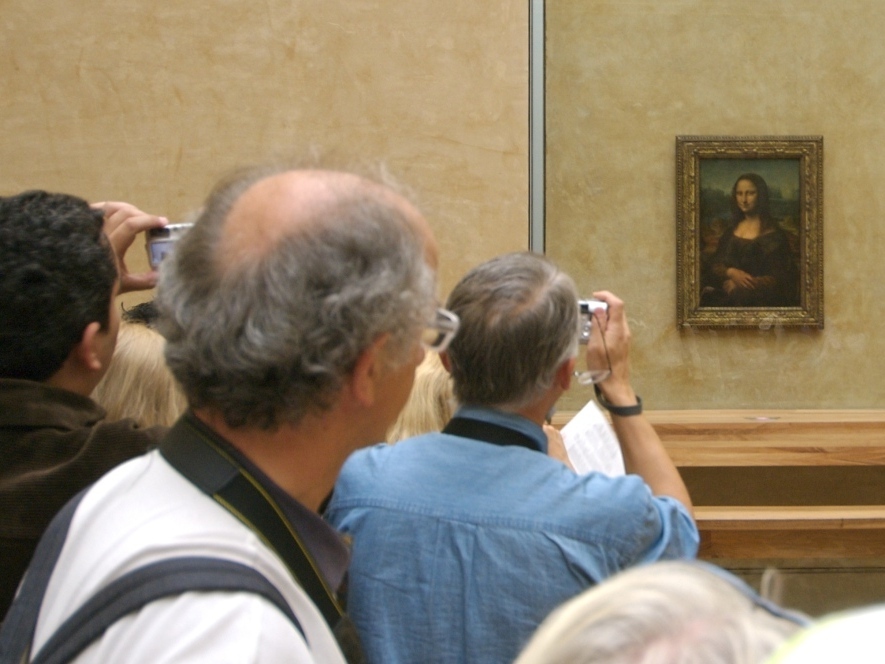
Of the more than 35,000 works of art in the Louvre, perchance none is more pop than the Mona Lisa.
KIKE CALVO/AP
A Masterpiece Returned
Twenty-eight months afterward he snatched it from the Louvre, Perugia finally made a pass at selling the "Mona Lisa" to an art dealer in Florence.
But the dealer was suspicious. He had the head of an Italian art gallery come accept a look at the painting.
A stamp on the back confirmed its authenticity.
"They said, 'OK, leave it with united states, and nosotros'll see that you lot go a reward,'" Tom Hoobler says. Perugia went back dwelling house. Just half an hour later, to his surprise, the police force were at his door.
"He said later on that he was trying to render it to Italy — that he was a patriot and it was stolen by Napoleon — and he was trying to return it to the state of his nascency," James Zug says.
And so, with much fanfare, the painting was returned to the Louvre. Perugia pleaded guilty to stealing information technology, and was sentenced to but viii months in prison.
Only a few days after his trial, Dorothy Hoobler says, World War I bankrupt out. Of a sudden, the drama of an fine art heist was off the forepart pages.
"This seemed like a very small-scale story," she says.
James Zug recently wrote most the Mona Lisa for the Smithsonian Magazine.
Source: https://www.npr.org/2011/07/30/138800110/the-theft-that-made-the-mona-lisa-a-masterpiece

Mag-post ng isang Komento for "French Articles on a Great Theft of Some Works of Art Took Place in 2007 French Magazine"